
 How-to
How an AI Recruiting Workflow Works for Home Services
Last Updated: November 15, 2026
Quick Summary
An AI recruiting workflow for home services is a structured process where software handles the repetitive parts of hiring, from first response to interview scheduling, while your team makes the final call. A candidate applies, AI acknowledges and engages the applicant, screening questions filter for fit, qualified candidates get scheduled, and your team reviews scored results before deciding.
- An ATS stores candidates but does not talk to them; a working workflow adds automated outreach, SMS recruiting, and scheduling.
- Respond to every applicant within minutes via automated message, because unread applications lose technicians to other offers.
- Screen against a role scorecard covering licenses, driving eligibility, hands-on experience, customer-facing skill, and availability.
- Keep screening to three to five mobile-friendly questions, with eligibility questions like license and availability first.
- Start with one role in one location, assign one owner, and review the criteria monthly before expanding.
Table of Contents
- Why Home Services Hiring Breaks Without a Recruiting Workflow
- What an AI Recruiting Workflow Looks Like in Practice
- An AI Recruiting Workflow for Home Services Example, Step by Step
- Step 1: Post the Job Where Field Technicians Search, and Write It for the Trade
- Step 2: Respond to Every Applicant Within Minutes
- Step 3: Screen Against a Role Scorecard, Not a Gut Feeling
- Step 4: Schedule the Interview and Confirm It
- Step 5: Keep Humans on the Decision and Track the Funnel
- What to Connect and What to Keep Separate
- A Realistic Rollout for a Small or Multi-Location Business
- Recruiting Screening Questions for Home Services Roles
- How AI Interview Scheduling Removes the Back-and-Forth
- Automated Applicant Follow-Up That Keeps Candidates Warm
- Where Human Review Still Belongs in an AI Hiring Process
- Get a Free Recruiting Audit for Your Home Services Team
- Frequently Asked Questions
Why Home Services Hiring Breaks Without a Recruiting Workflow
An AI recruiting workflow for home services is a structured process where software handles the repetitive parts of hiring, from first response to interview scheduling, while your team makes the final call.
Picture a Tuesday morning at a plumbing company: two technicians called out, the office manager is dispatching jobs and fielding emergency calls while three applicants sit unopened. By Thursday, two have taken jobs elsewhere. This is the standard failure mode, and it has nothing to do with applicant quality.
At Pilot AI, we see the same pattern across HVAC, electrical, cleaning, and dental offices: hiring competes with daily operations, and operations always win.
U.S. Bureau of Labor Statistics occupational outlook for installation, maintenance, and repair occupations
What an AI Recruiting Workflow Looks Like in Practice
The distinction matters. Many teams already have an applicant tracking system, but an ATS is a filing cabinet. It stores candidates; it does not talk to them.
For a deeper look at how these pieces fit into a broader talent acquisition strategy, our guide to implementing AI in talent acquisition workflows walks through the full picture.
Society for Human Resource Management guidance on talent acquisition technology
An AI Recruiting Workflow for Home Services Example, Step by Step
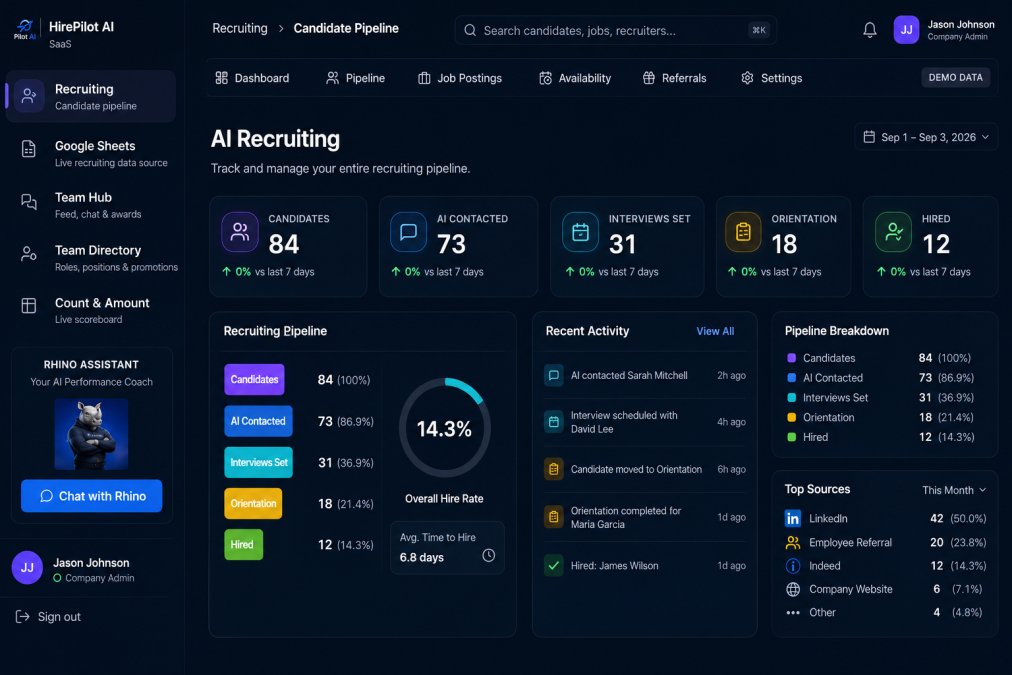
Here is a hypothetical example of an AI recruiting workflow for home services in action, built for a residential HVAC company hiring two field technicians. The same sequence applies to plumbing, electrical, cleaning, and dental-office roles, with screening criteria swapped for each trade.
Step 1: Post the Job Where Field Technicians Search, and Write It for the Trade
Field candidates do not browse the same channels as office staff. Post to the job boards and local listings where technicians actually look, and keep requirements specific: EPA Section 608 certification where refrigerant work is involved, a valid driver's license and insurable driving record, hands-on field experience, and willingness to work on-call rotations.
Write the posting so must-haves are visible in the first few lines. A technician scanning on a phone should tell within seconds whether the role fits their license, schedule, and commute.
Step 2: Respond to Every Applicant Within Minutes
Speed matters. When an applicant responds to your posting, an automated message can acknowledge them and ask the first screening question. This is where most home services teams lose candidates: the application sits unread until someone has a spare moment, and a technician who applies on a lunch break will often accept another offer before your office manager opens the inbox.
For teams handling high applicant volume, our guide to automating high volume recruitment covers how to keep response times short without adding headcount.
Step 3: Screen Against a Role Scorecard, Not a Gut Feeling
Once screening answers come back, the workflow scores the candidate against criteria you defined in advance. For field roles, a practical scorecard covers five buckets:
- Licenses and certifications. Current trade license or EPA certification where the role requires it, plus any manufacturer or safety certifications the job depends on.
- Driving eligibility. Valid license, insurable record, and comfort with a company vehicle if the role includes one.
- Hands-on experience. Years in the trade and the specific equipment or systems the candidate has worked on.
Score each bucket as pass, review, or fail rather than a single number. A candidate who fails the license check is a clear no; one light on a certification but strong elsewhere should land in human review, not the reject pile.
Step 4: Schedule the Interview and Confirm It
Qualified applicants can choose from open interview slots, and the workflow can send confirmations and reminders. For field roles, add a short note about where to park, who to ask for, and whether to bring tools or certifications, small details that reduce no-shows.
Step 5: Keep Humans on the Decision and Track the Funnel
Your hiring manager reviews the screening answers and conducts the interview before any offer. Track each stage, applied, contacted, screened, scheduled, interviewed, offer, so you can see where candidates drop off. Heavy fall-off between screening and scheduling usually points to slow slot offers or a mismatch between posted availability and real shifts.
What to Connect and What to Keep Separate
Keep candidate records organized in one place, and decide up front which system is the source of truth for each type of data. Decide up front which system is the source of truth for each field, and keep candidate personal data limited to what the hiring decision needs.
A Realistic Rollout for a Small or Multi-Location Business
Start with one role in one location. Define the scorecard, write the screening questions, and run the workflow for a few weeks before expanding.
U.S. Bureau of Labor Statistics occupational outlook for installation, maintenance, and repair occupations
Here is the five-step sequence the article walks through for a residential HVAC company hiring two field technicians.
| Step | What to do |
|---|---|
| Step 1 | Post the job where field technicians search, with must-haves up front |
| Step 2 | Respond to every applicant within minutes via automated message |
| Step 3 | Screen against a role scorecard: licenses, driving, experience, customer skill, availability |
| Step 4 | Let qualified applicants choose open interview slots; send confirmations and reminders |
| Step 5 | Keep humans on the decision and track each funnel stage |
Recruiting Screening Questions for Home Services Roles
Good screening questions for home services roles test what actually predicts field success: license and certification status, driving record eligibility, availability for on-call and weekend work, physical requirements, and comfort with customer-facing work. Ask these in the first automated exchange, not in a first interview, so your team spends interview time on candidates who can actually do the job.
A Role-by-Role Starter Scorecard
The questions below are a starting point, not a legal checklist. Adjust them to the specific role, the state or local requirements that apply, and your own hiring policy. Label them as hypothetical examples when you adapt them.
HVAC technician
- Do you hold a current EPA Section 608 certification, and which type?
- How many years of residential or commercial HVAC experience do you have?
- Are you able to work on-call rotations and seasonal overtime?
Plumber
- Do you hold a current plumbing license or journeyman certification for this state?
- Have you worked on both service calls and installs?
- Are you comfortable explaining repairs and pricing directly to homeowners?
Electrician
- Do you hold a current electrician license or apprenticeship standing?
- What types of systems have you worked on, residential, commercial, or both?
- Are you available for emergency and after-hours calls?
Cleaning and facilities
- Do you have experience with the cleaning methods and equipment this role uses?
- Are you available for the shift pattern, including weekends if required?
- Are you comfortable working in occupied homes and businesses?
Dental office
- Do you hold the certifications or licenses this role requires in this state?
- How many years of chairside or front-office experience do you have?
- Are you available for the office's operating hours, including any evenings or Saturdays?
Keep the List Short and Mobile-Friendly
Every extra question lowers completion rates, and mobile-first applicants abandon long forms quickly. Three to five questions is enough to separate serious field candidates from noise. Put eligibility questions first, license, driving, availability, because a candidate who fails one should not be asked to complete the rest.
Validate the Criteria Before You Trust Them
Screening criteria can quietly filter out good candidates, especially when requirements are written too narrowly, for example, a scorecard requiring a certification the role does not actually need. Review the criteria regularly against the people who succeed in the role, and keep a manual override so a hiring manager can pull a candidate back into review.
Keep Humans on Consequential Decisions
AI can ask the questions, score the answers, and route candidates. It should not be the final word on who gets hired. A hiring manager should read the actual screening answers and conduct the interview before any offer. Our guide to spotting and reducing AI bias in recruitment software covers practical safeguards for keeping humans in control.
Handle Candidate Data Carefully
Collect only the information the hiring decision needs, store it in your applicant tracking system rather than scattered inboxes, and set a retention period for applications that are not selected. If an applicant asks for an accommodation during screening, route that request to a person rather than letting an automated flow handle it.
Society for Human Resource Management guidance on talent acquisition technology
How AI Interview Scheduling Removes the Back-and-Forth
AI interview scheduling cuts the email chain entirely. Instead of trading availability messages across days, the system reads your team's calendar, offers real open slots to the candidate, and confirms the booking automatically.
The hidden benefit is reminders. Automated confirmations and follow-up messages reduce the ghosting that plagues hourly and field hiring, where candidates juggle multiple applications and shift schedules.
Automated Applicant Follow-Up That Keeps Candidates Warm
Automated applicant follow-up can help keep candidates informed with less manual effort. Timely, respectful messages to candidates who are not selected or who are on hold keep your pipeline warm for future openings.
This is the part most home services teams skip, and it costs them. Field technicians talk to each other. A company that responds promptly and communicates clearly builds a reputation that makes the next hire easier.
Where Human Review Still Belongs in an AI Hiring Process
Human review belongs at every decision point in an AI hiring process. AI can screen, schedule, and follow up. It should not be the final word on who gets hired.
Watch out: the most common mistake is treating an automated screen as a verdict. Screening criteria can quietly filter out good candidates, especially when requirements are written too narrowly.
Get a Free Recruiting Audit for Your Home Services Team
If your applicants wait days for a reply, your scheduling runs on email chains, and your follow-up depends on whoever remembers, the workflow is the bottleneck, not the candidates.
Pilot AI offers AI-powered business tools, including recruiting solutions and performance tracking systems, to help streamline operations. Before you commit, it helps to know what booking a demo for HR automation software involves and how to prepare. When you are ready, get a free recruiting audit and we will review your applicant response, follow-up, scheduling, and potential recruiting bottlenecks.
Hiring for field roles will always compete with the daily demands of running the business. The teams that win stop relying on spare moments and put a workflow in place that responds every time.
Frequently Asked Questions
How can AI help with recruiting for home services?
AI handles the repetitive parts of hiring: replying to applicants quickly, asking the same screening questions every time, and offering interview times that fit your schedule. Your managers still review candidates and make every hiring decision. The AI recruiting workflow supports the process; it does not replace judgment.
What does an AI recruiting workflow look like from start to finish?
A typical flow runs: a job is posted, applicants reply, your team reviews screening answers, qualified candidates choose an interview slot, and the hiring manager reviews candidate information before the interview.
What screening questions should home services employers ask?
Focus on the requirements that decide whether someone can do the job: relevant license or certification, years of hands-on experience with the systems you service, a valid driver's license and clean driving record where driving is required, comfort with on-call rotations, and availability for the shift you need. Add one question about how they explain a repair to a customer. Keep the list short and ask the same questions of every applicant.
Can AI respond to applicants and schedule interviews automatically?
Pilot AI's recruiting solutions can support applicant response and interview scheduling. Ask the vendor for details on how these features work for your team. The hiring manager still chooses who to interview and conducts the interview. Automatic scheduling mainly removes the email tag that causes candidates to go cold.