 Listicle
7 AI Tools for Employee Performance Tracking to Watch
Last Updated: October 28, 2026
Quick Summary
AI tools for employee performance tracking are platforms that use automation to collect goals, feedback, and review data, then surface patterns for managers. They reduce manual admin in review cycles and keep performance conversations consistent across departments. Options range from review-focused tools to full suites that connect hiring, training, and performance tracking.
- Choose a review-focused tool when the formal review cycle is your main problem.
- Choose a full suite when hiring, onboarding, training, and reviews live in separate systems.
- AI can summarize feedback and flag missing check-ins, but managers keep the assessment and decision.
- Confirm the vendor's current feature list and pricing directly before buying.
- Run one review cycle with a single team before a company-wide rollout.
Table of Contents
- Quick Comparison: AI Tools for Employee Performance Tracking
- How We Evaluated These Performance Tracking Tools
- 1. Pilot AI: Recruiting, Training, and Performance Tracking in One Suite
- 2. Workleap: Engagement, Feedback, and Goal Tracking Combined
- 3. 15Five: Performance Reviews and Management for Mid-Market Teams
- 4. Culture Amp: A Performance Management and Review Platform
- 5. PerformYard: A Review-Focused Option for Mid-Market Organizations
- 6. Windmill: AI Performance Reviews for Mid-Market Companies
- Frequently Asked Questions
Quick Comparison: AI Tools for Employee Performance Tracking
Performance tracking is the practice of collecting, reviewing, and acting on employee performance data across goals, feedback, and reviews. This guide covers platforms related to employee performance tracking.
Below is an at-a-glance comparison.
| Tool | Core Strength | Best For | Pricing |
|---|---|---|---|
| Pilot AI | Recruiting, training, and performance tracking in one suite | Teams that want hiring and performance connected | Contact vendor |
| Workleap | Engagement, feedback, pulse surveys, goal tracking | Teams focused on engagement | Contact vendor |
| 15Five | Performance reviews and management | Mid-market review cycles | Contact vendor |
| Culture Amp | Performance management and review platform | Organizations comparing platforms | Contact vendor |
| PerformYard | Review-focused workflows | Mid-market review programs | Contact vendor |
| Windmill | AI-assisted performance reviews | Mid-market AI review pilots | Contact vendor |
How We Evaluated These Performance Tracking Tools
SHRM guidance on performance management
1. Pilot AI: Recruiting, Training, and Performance Tracking in One Suite
Pilot AI is an AI-powered suite that includes recruiting solutions, automated training capabilities, and performance tracking systems. To see it in action, learn how to book a demo for HR automation software.
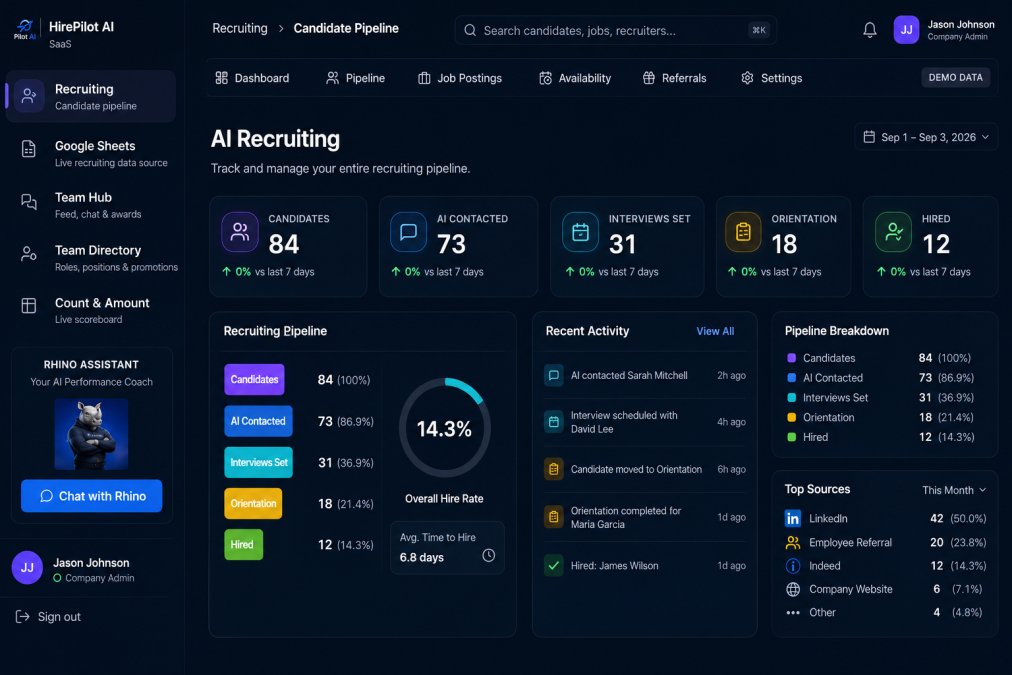
An applicant responds, AI helps handle the conversation and scheduling, your team tracks progress, and humans make the hiring decision.
Pros:
- Recruiting solutions, automated training capabilities, and performance tracking systems
- AI helps handle applicant conversations and scheduling
- One system for the full employee lifecycle
Cons:
- Not a dedicated, standalone review platform, so teams wanting only review cycles may find it broader than needed
- Pricing is quote-based, so you need to ask
Best for: teams scaling headcount that want hiring and performance in one place. Skip if: you only need a formal annual review module and nothing else.
2. Workleap: Engagement, Feedback, and Goal Tracking Combined
Workleap is an AI-powered platform for employee engagement, 360-degree feedback, pulse surveys, and goal tracking. The pitch is straightforward: keep a read on how people feel while tracking what they are working toward.
The engagement angle is the differentiator. Pulse surveys give managers a recurring signal rather than a once-a-year snapshot, and 360-degree feedback pulls input from peers, not just the direct manager. Goal tracking ties those signals to actual objectives.
Pros:
- Combines feedback and pulse surveys with goal tracking
- 360-degree feedback built in
- Engagement focus suits teams with retention concerns
Cons:
- Deep review-cycle configuration is not its core strength
- Integrations and pricing are not publicly detailed
Best for: teams that want engagement data feeding into performance conversations. Skip if: you need heavy, configurable review workflows.
3. 15Five: Performance Reviews and Management for Mid-Market Teams
15Five is a performance management platform built around reviews and manager-employee check-ins. It appears consistently in current performance management roundups, which tells you it has staying power in the mid-market.
The tool's logic is continuous: regular check-ins feed into review cycles, so the annual review is a summary of a year of conversations rather than a surprise. That structure is what makes it a fit for mid-market teams with managers who need a repeatable rhythm.
Pros:
- Appears in multiple current performance management lists
- Suits AI-supported review workflows
- Mid-market focus
Cons:
- Specific AI features and current pricing are not publicly verified
- Less suited to very small teams without formal review cycles
Best for: mid-market teams running structured review cycles. Skip if: you are a five-person shop that just wants lightweight goal tracking.
If review meetings are part of your process, our steps for conducting remote performance review meetings pair well with this kind of tool.
4. Culture Amp: A Performance Management and Review Platform
Culture Amp is a performance management and review platform named among AI performance review tools in current comparisons. Its reputation rests on review and engagement depth rather than breadth of HR functions.
Where it earns its place: organizations that treat performance and culture as one problem. Review cycles, feedback, and engagement measurement sit in one platform, which reduces the number of places a manager has to look.
Pros:
- Included in focused comparisons of AI performance review tools
- Appears across multiple performance management resources
- Strong review and engagement pairing
Cons:
- Detailed capabilities and pricing are not publicly verified
- Can be more platform than a small team needs
Best for: organizations comparing serious performance platforms. Skip if: you want a single-purpose review tool with minimal setup.
For a head-to-head view of how leading platforms differ, this Lattice vs Ciphr performance tracking comparison is a useful reference point on tradeoffs.
5. PerformYard: A Review-Focused Option for Mid-Market Organizations
PerformYard is a performance review option aimed at mid-market organizations. It shows up in current comparisons of AI performance review tools, and its positioning is narrower than the engagement-led platforms above.
That narrowness is the point. If your problem is the review cycle itself, a review-focused tool removes the distraction of modules you will never configure. Teams that already have an engagement survey vendor often prefer this shape.
Pros:
- Included in comparisons focused on AI performance reviews
- Review-first design
- Easy to evaluate alongside other named tools
Cons:
- Current pricing and detailed capabilities are not publicly verified
- Engagement and pulse survey features are not its focus
Best for: mid-market teams whose main pain is the review cycle. Skip if: you want engagement measurement in the same platform.
6. Windmill: AI Performance Reviews for Mid-Market Companies
Windmill is listed as an AI performance review tool for mid-market companies. It appears in focused comparisons of AI review tools, which makes it a reasonable candidate for a pilot rather than a full rollout.
The sensible approach with any AI review tool is a contained test. Pick one department, run one cycle, and compare the output quality against your current process before committing. That is how you find out whether the AI summaries actually save manager time or just add a review step.
Pros:
- Appears in a focused comparison of mid-market review tools
- Relevant to organizations piloting AI in reviews
- Mid-market orientation
Cons:
- Detailed features and pricing are not publicly verified
- Limited independent information available
Best for: mid-market teams piloting AI-assisted reviews. Skip if: you need a fully documented feature set before you will even take a call.
Frequently Asked Questions
What are the best AI tools for employee performance tracking?
The right pick depends on your size and goals. Pilot AI offers recruiting solutions, automated training capabilities, and performance tracking systems. Compare features before you commit.
How does AI track employee performance?
AI tools may be used to support performance tracking. They do not replace human judgment. The team makes decisions.
What metrics can AI use to measure employee performance?
Common employee performance metrics include goal completion, feedback frequency, pulse survey scores, review cycle participation, and task or project outcomes. AI can also track response times and follow-up rates in customer-facing roles. Pick a small set that matches the job, review them with employees, and avoid metrics that reward activity over results.
Can AI tools evaluate employee performance fairly?
Human oversight remains important when using AI in performance reviews. Keep managers involved in decisions.
What should businesses look for in an AI performance management tool?
For teams that also hire at volume, Pilot AI offers recruiting solutions, automated training capabilities, and performance tracking systems.